Anyone who has spent time accessing other states of consciousness -- whether through fasting, meditation, ecstatic dance, magic, plant medicine, or synthetic chemicals -- knows that the worlds we enter on the other side of the veil are very real, and so are the dangers we face there.
Psychedelic plants and chemicals can rapidly bring people to realms that practitioners spend years trying to reach through other means. This can make them very efficient tools for deep transformational work. But it also means that they can bring people who don't have the well developed psychic defenses of a trained shaman to worlds subtly but powerfully different from anything they have experienced before -- a potentially dangerous situation.
Working as an herbalist at festivals where a lot of psychedelics are moving through the crowd, I have begun to develop both a model of what is happening inside a person who is having a "bad trip" and some protocols to help them through what they are struggling with. What follows are some notes on my approach and understanding that will hopefully spur more discussion among herbalists and other healers working with people who use psychedelic plants and chemicals.
A Biological Model
Psychedelic compounds move the plants, animals, and humans that ingest them into a highly creative nonlinear state of consciousness.(1)
In humans they seem to operate by opening the sensory gating channels that bring information about sights, sounds, sensations, tastes, smells, and electromagnetic field fluctuations from the heart and the other sense organs to the neocortex. The neocortex works to extract meaning from the signals it is receiving. In this heightened state of sensory awareness, the neocortex has to work harder to extract meaning from the information coming in from the world around it, forcing it into a state of nonlinear creativity.
For some, though, this flood of sensation and information coupled with the discovery of new meanings in once mundane things can trigger acute anxiety. And for those who have been severely traumatized in this realm, that feeling of anxiety can bring back body memories of their original traumas (in some combat veterans and some survivors of sexual trauma, even Cannabis, with its milder psychedelic qualities, can trigger full scale dissociative episodes.)
The sense of metaphysical vertigo can be traumatizing in and of itself -- and can have lasting effects when a person returns to "ordinary" consciousness. My interpretation of "acid flashbacks" is that they have nothing to do with residual chemicals in the spine, but rather are PTSD (Post Traumatic Stress Disorder) related dissociations brought on by external triggers that remind someone of some aspect of a moment of terror on either side of the veil.
A Magical Model
The purple-blue tinge of the bruised flesh of mushrooms of the Psilocibe genus is a signature of the opening of the Third Eye and the Crown Chakra.
The sudden and dramatic opening that the medicine of these mushrooms and the similar medicines of various other plants, fungi, and chemicals bring on can open someone to states of consciousness that reveal the existence of other worlds, other orders of reality.
These worlds are populated by their own flora and fauna and even societies with complex behaviors, rules of etiquette, and feeding behaviors.
Shamanic and magical traditions prepare people to navigate these worlds through years of practice in sensing and moving energies. Just as a city dweller suddenly dropped into the middle of the desert or the forest would be at a loss for how to survive, those who have not prepared for a journey on the other side of the veil between worlds can find themselves stumbling into difficult and dangerous situations. The fact that the territories of these worlds overlap and layer over each other can lull travelers into a false sense of familiarity and security.
As one teacher of mine says, not all beings without bodies have our best interests in mind. Beings that prey on us have been known to wear very seductive forms on the other side of the veil.
In helping people struggling with acute panic during a psychedelic trip its important to acknowledge the reality of what is happening in and around her -- her experiences are not metaphorical, they are lived experiences that occur in another world.
Handling an Acute Psychedelic Crisis
My first response when someone is panicked but lucid during a psychedelic trip is to get the person to a physically comfortable place, preferably accompanied by one or two friends, verbally let her know that she is in no physical danger and that she will come back from the place where she is, and encourage and model slow, calm breaths. Then I offer a calming tea.
During a festival I always keep a big pot of tea going containing Skullcap/Blisswort (Scutellaria spp.), Passionflower (Passiflora spp.), and Wood Betony (Stachys officianalis.) Note the violet/blue color of these flowers.
Passionflower is specifically indicated for "irritation of the brain, nervousness, restlessness, sleeplessness with muscle twitching, or circular thinking"(2) -- symptoms typical of the overstimulation brought on my psychedelic plants and chemicals. While some practitioners are concerned about the theoretical possibility that as a mild MAO Inhibitor, Passionflower could be dangerous for someone taking a Selective Seretonin Reuptake Inhibitor (eg.Prozac), I have not been able to find any documented cases of this kind of negative drug interaction, and my experience and that of other herbalists I have talked with suggests that Passionflower is generally safe for most people. However since depending on someone's degree of coherence during a psychedelic trip, it may be difficult to ascertain whether that person is taking an SSRI, those concerned about the theoretical risk the interaction presents might choose not to use the herb in this kind of situation.
The inclusion of Blisswort is more a product of intuition and habit than a carefully reasoned decision -- she tends to be an excellent adjunct to Passionflower and as a nervine that is not sedating she has an ability to help level off energies without bringing someone "down" too hard and too fast.
Wood Betony serves multiple purposes in this instance. As an herb with a strong affinity for the solar plexus, it is strongly grounding, helping to move consciousness into that region of the body, anchoring it to a degree in the physical world. Darcey Blue French writes that Wood Betony "helps to ground people here on earth, for those stuck in repetitive mental patterns, or in mind/head stuff who need to come down and think from their center, and be in their body."
Wood Betony is also a traditional herb of exorcism and psychic protection. French writes:
"Stachys has long been used as an agent of protection from evil ‘spirits’, nightmares and visions, and to repel venomous creatures like snakes. It was planted in churchyards as protection against evil, and the Greeks said, 'it shields him against visions and dreams.' It is claimed in folklore when surrounded in a ring of wood betony leaves, snakes would fight and kill each other. Those who wear it as an amulet would find 'good against fearful visions, and driving away devils and despair.'"(3)
Yarrow Flower Essence or an energetic dose (a few drops) of a Yarrow flower tincture may also offer a degree of psychic and energetic protection.
Occasionally if the tripping person seems mired in dark thoughts I add Lavender flowers to the tea. Tulsi (Ocimum sacnctum) might also make sense here because of its ability to disperse stuck thoughts and emotions.
For cases of more severe emotional trauma, bordering on and moving into dissociative states, some members of the Anemone family can be of great assistance. In an article on using various Anemone species to treat panic attacks, 7Song describes using Anemone to treat people having "bad trips" and people having trouble sleeping after taking LSD at Rainbow Gatherings.(4) Michael Moore used Pasque Flower (Anemone pulsitilla) to treat these conditions.(5) Buhner suggests that Pasque Flower works to regulate the sensory gating channels. (6)
It is important to note that in a small number of people, primarily those with constitutional tendencies toward excess heat, Anemone species can be agigating rather than calming.
So far, I have worked exclusively with a tincture of Anemone tuberosa. In mild cases, a 2 or 3 drops of the tincture will often help to calm a person immensely. In one more severe case, I gave 30 drops of Anemone tuberosa tincture and 5 drops of Monotropa uniflora tincture in water to an agitated, incoherent, and borderline violent 200 pound man who had taken a large dose of LSD, and he was docile within 10 minutes of drinking the water he was docile, within 30 minutes he was asleep.
I made the decision to include Ghost Pipe (Monotropa uniflora) in the formula I administered in this case based on Ryan Drum's reported success using the plant to calm an agitated and menacing man whose state was brought on by "sleep deprivation, dehydration, too much recreational medication, and no real food for many days."(7) and my intuition that, like Anemone pulsitilla and Anemone tuberosa, Monotropa uniflora acts on the sensory gating channels.
The plant's form suggests both the spinal column and brain stem and a tunnel between worlds. The irridescent violet of the tincture suggests an affinity for the Crown Chakra. Energetically it is cooling.
In my view, hospitalization is to be avoided unless you are unable to prevent a person from being violent toward herself or others, the person may have ingested a toxic substance while tripping, or the person has sustained physical injuries. Emergency room treatment for a "bad trip" will always involve taking a frightened and disoriented person with heightened emotional, sensory, and energetic awareness and putting that person into a place full of frightened people, many of them in extreme pain. It will often involve physical restraint and/or the administration of heavy anti-psychotic drugs designed to bring the patient quickly back into consensual reality -- a potentially traumatic ripping from one world into another. It will usually involve the administration of treatment by people who do not acknowledge the reality of the experiences the patient is having and are not concerned about the possibility that the person may have been subjected to psychic attacks.
Thoughts on further treatment
As an herbalist administering first aid at festivals, I seldom have a chance to follow up with the people I have helped in the midst of psychic and emotional traumas connected with the use of psychedelics. But I would like to offer a few thoughts on follow-up treatment for people recovering from a traumatic psychedelic experiences:
-- It is of the utmost importance that the person be given an opportunity to integrate her experiences. When she is ready to share them she should be treated with the same respect and support as a survivor of a traumatic event that took place in ordinary reality
-- Two herbs seem likely to be of great benefit to someone recovering from this kind of trauma:
Tulsi (Ocimum sanctum) is useful when the "patient is fixated on a specific traumatic event, and complains of fatigue and mental fog" according to David Winston. (8) Pam Montgomery writes that "Besides being a great protector plant it helps in soul retrievals, as it is able to locate exiled souls and bringing them home."
-- Wood Betony (Stachys officianalis) may help to address some of the lingering energetic attachments from time spent in other worlds. In his monograph on the plant, Jim McDonald writes:
"Another of Wood Betony's virtues, [. . .] is it's ability to dispel evil and ward of spirits of ill intent. The manifestations of that need not be supernatural (though I think it good protection from bad magic and those who deal in that and Matthew Wood has used it on several occasions for those suffering PTSD from alien abductions) sometimes we may know or be related to such people. To access these more esoteric virtues, one might carry the herb with them in a medicine bag, or rub doses of the tincture into their wrists or temples. Sure, this may make you question how very weird your belief system is becoming, but when you see situations change around you in a way that reinforces this usage a few times, you can just flow with it. It's quite likely, after all that your friends and family already think you a bit 'eccentric.'" (10)
Its worth noting that "alien abduction" may be a modern interpretation of the ancient and universal experience of being taken or led by strange beings into other worlds. It stands to reason that a plant that helps survivors of these experiences would also be of assistance to those who enter those realms voluntarily but return scarred.
The flower essence of Eastern Skunk Cabbage (Symplocarpus foetidus) is, in my experience, specific to smoothing the transition between worlds.
-- In some cases, especially when someone's personality or behavior seem dramatically changed after a traumatic psychedelic experience , the assistance of a shaman or root worker may be necessary to retrieve parts of the self left behind in other worlds or to dispell spirits and energies that have attached themselves to a person.
____________________________________________________________________
UPDATE -- OCTOBER, 2010
With another season of festival first aid under my belt, now seems like a good time to make some updates.
For cases of mild to moderate anxiety associated with psychedelics where the person doesn't necessarily want to "come down" I'm now generally using variations on a formula including Wood Betony (for grounding and protection), Mimulus spp. (for feelings of dread), Passionflower (for circular thoughts and to cool the mind), and Schizandra (to calm disturbed Shen, especially where breathing is fast and shallow.) If there are strong heat signs or if there is an edge of anger to the anxiety I'll sometimes add Melissa. If there is fixation on a particular negative thought or emotion I'll add Holy Basil. If the heart is racing I'll add Motherwort.
I realize there is some concern that Passionflower as a possible MAOI may further potentiate tryptamines, but a) I have never seen this happen at therapeutic doses and b) if a person is merely hitting a rough spot in a journey, the goal is to bring grounding and protection, not necessarily to abort the trip, so further potentiating tryptamines is not necessarily a bad thing in and of itself.
Phyllis Light mentioned to me at the Traditions in Western Herbalism Conference that she has calmed people on LSD by having them drink a glass of milk. When Darcey and I recently had a phone call from someone who was having a bad trip and didn't have access to the herbs we would normally use we had her drink a glass of milk and put her feet in warm water. This succeeded in calming her to the point where she was able to lie down and sleep it off.
In cases of severe anxiety marked by agitation I have stopped using Anemone in part because I am concerned about the potential of paradoxical reactions -- I've not seen this happen in a situation related to psychedelics but I have seen people who tend to run hot become more agitated by a very small dose of Anemone tuberosa, and given that the kind of aggressive agitation I have seen in some cases of people having "bad trips" feels like a Pitta excess to me I'd rather play it safe and use other herbs instead.
What I've been using in its place has been Ghost Pipe. In a dozen or so cases in which someone has come to the first aid tent because she wants her trip to be over or someone has been brought to the tent because he has become aggressively agitated on LSD, and in one case of someone experiencing tremors and terror from PCP, I've seen 30 drops of Ghost Pipe tincture administered between one and three times calm people down to the point where they are able to relax and usually sleep (and then wake up without any major disorientation.)
I have seen two cases in the past year of men in their early twenties becoming physically violent and completely dissociated while on LSD. In both cases they were men who had always seemed kind and gentle to their friends (which I believe because in both cases their kind and gentle friends helped us hold them over the course of several hours and never lost their tempers.) In both cases we later found out these men were also on Adderall. In both cases the things the men were shouting about while trying to attack people suggested the strong possibility of childhood sexual trauma. And in both cases multiple health care practitioners involved felt the very clear sense of another entity partially controlling their actions.
The Adderall connection feels important here for two reasons. The first is that I think PTSD in young men is often misdiagnosed as ADHD, and the suppressive therapies used to treat their symptoms may prevent emotional release, worsening the underlying condition. Secondly I theorize that when LSD brings up buried trauma, a stimulant like Adderall may act to further stimulate the adrenals and to increase physical energy and stamina increasing the likelihood of physical aggression.
In the first case, we were able to administer Ghost Pipe orally, and we watched as our patient's pupils contracted and his eye motion became more responsive to external stimuli. But he continued to kick, bite, and scream for another several hours. We made the choice not to evacuate him because getting him in an ambulance would have required police assistance and we did not want to see him face charges of assaulting a police officer. Once he was physically exhausted his friends took him to a hospital.
In the second instance, we were unable to administer any herbs orally in doses capable of making a difference -- a few sips from a water bottle with various herbs added was the best we could do. We initially applied Rescue Remedy to the temples and wrists and smudged with Tobacco, Osha, and White Sage. Eventually we were able to get the patient to smoke a combination of Skullcap, Tobacco, and Cannabis (an Indica-dominant strain) and chew a small piece of Calamus root. This combination seemed to have a calming effect, and he was eventually able to leave with his friends still tripping but no longer aggressive. Several of us had side conversations with his friends about the importance of encouraging him to seek counseling in some form.
Ironically, in both these situations, I could see entheogens in a controlled, ceremonial situation under the guidance of an experienced healer being useful medicines for helping the patient work with the repressed trauma. But clearly the chaotic setting of a festival is not the right place for that work to begin.
____________________________________________________________________
(1) Stephen Harrod Buhner. "The Ecstatic Journey and the Sacred Teachings of Plants" workshop at Sage Mountain, East Barre, VT, June 26-28. The subsequent information about sensory gating channels and the neocortex reflects my own extrapolation from Buhner's comments.
(2) David Winston. "Differential Treatment of Depression and Anxiety with Botanical Medicines." (C) 2006, Revised 2007. http://www.herbaltherapeutics.net/Differ_Treat-Depression.pdf
(3) Darcey French "Wood Betony: Stachys officianalis." Unpublished monograph, March 2008.
(4) 7Song. "Herbalists's View: Anemone for Panic Attacks." http://7song.com/files/Herbalists%20View-%20Anemone%20for%20Panic%20Attacks.pdf
(5) Darcey French, personal communication.
(6) Buhner
(7) Ryan Drum. "Three Herbs: Yarrow, Queen Anne's Lace, and Indian Pipe." http://www.ryandrum.com/threeherbs.htm#IndianPipe
(8) Winston.
(9) Pam Montogmery. Plant Sprit Healing. Rochester, VT: Bear & Company, 2008.
(10) Jim McDonald. "Wood Betony -- Stachys officianialis." http://herbcraft.org/betony.html
Saturday, August 22, 2009

Thursday, August 6, 2009
My Place is at the Edge
The headline of a recent action alert from the American Association for Health Freedom urging support for provisions of the omnibus health care legislation now in Congress that would require insurance companies to cover treatments by all health care professionals licensed by the states they live in (including may naturopaths and accupuncturists) asks "Has the Time Come for Complementary and Alternative Medicine to Join the Mainstream?"
While I understand and appreciate and share the organization's goal of giving people more control over the choices they make about how they take care of their own bodies, the language of the question troubles me.
As an herbalist, I am not providing an alternative or a complement to anything. I am practicing an art and science and magic at least as old as humanity-- the practice of working with plants to help people remember how to recover and maintain the dynamic balance of health. It has nothing to do with the effort to "diagnose, treat, or cure" disease because it is older than the concept of disease.
What authority I have comes from my relationships with the plants and people I work with. It is a sacred trust, not something that can be judged and regulated by any agency or licensing board.
The licensing of doctors and the prosecution of those who practice medicine without a license has its origin in the witch persecutions of the sixteenth and seventeenth centuries.
Well into the 1600's, most rural people in Europe were Christians in name only, believing and practicing in traditions that bound them to land they worked in common. Their medicine came from that land, and its knowledge and traditions were kept alive primarily by women -- midwives and "herbwyfes."
Outlawing these traditional forms of medicine and making medicine the work of a small class of wealthy men trained in universities was part and parcel of an effort to break rural people's connection to the land and to strip midwives and herbwives of the power they still had in their communities -- a power that came from the intimate relationship these healers had with the living Earth. This was bound up with the replacement of living oral traditions of medicine with a single fixed approach that could be altered only with the permission of the recognized authorities of the new profession. All of it a patriarchal game.
Schemes to regulate and license herbalists reflect the same thinking that underlies the licensing of doctors -- the idea that there is a set body of knowledge, an established set of approaches and practices, to which all herbalists must adhere. But the plants themselves don't follow the rules others would set out for them. They are constantly changing in response to the world around them. Those who would work with them need to be able to flow with those changes and trust the messages the plants give them more deeply than they trust anything they learn from the best book or the greatest human teacher.
To those who would argue that the licensing and regulation of herbalists is necessary to protect the public from bad herbalists, I say that the existence of the medical malpractice insurance industry and the legions of medical malpractice lawyers provides us with ample evidence that the licensing of doctors hasn't protected the public from bad doctors. The best protection people have is a sense of responsibility for their own health and the intimate knowledge of their own bodies that gives them a sense of when something is moving them closer to health and when it is moving them further away.
I have no interest in obtaining certification from any government or even any board of herbal elders.
Nor do I have any aspirations toward being part of the mainstream -- the nature of my work involves dancing at the boundaries of the human and the wild.
The shaman, the witch, the healer have always lived at the edge of the village or outside it -- serving the community without being fully part of it. Only by living and working outside the constraints and customs and assumptions of the culture is it possible to maintain the fierce innocence necessary to maintain relationships with plants, animals, and gods.
My place is at the edge. Come, meet me there, where we can both be transformed.
While I understand and appreciate and share the organization's goal of giving people more control over the choices they make about how they take care of their own bodies, the language of the question troubles me.
As an herbalist, I am not providing an alternative or a complement to anything. I am practicing an art and science and magic at least as old as humanity-- the practice of working with plants to help people remember how to recover and maintain the dynamic balance of health. It has nothing to do with the effort to "diagnose, treat, or cure" disease because it is older than the concept of disease.
What authority I have comes from my relationships with the plants and people I work with. It is a sacred trust, not something that can be judged and regulated by any agency or licensing board.
The licensing of doctors and the prosecution of those who practice medicine without a license has its origin in the witch persecutions of the sixteenth and seventeenth centuries.
Well into the 1600's, most rural people in Europe were Christians in name only, believing and practicing in traditions that bound them to land they worked in common. Their medicine came from that land, and its knowledge and traditions were kept alive primarily by women -- midwives and "herbwyfes."
Outlawing these traditional forms of medicine and making medicine the work of a small class of wealthy men trained in universities was part and parcel of an effort to break rural people's connection to the land and to strip midwives and herbwives of the power they still had in their communities -- a power that came from the intimate relationship these healers had with the living Earth. This was bound up with the replacement of living oral traditions of medicine with a single fixed approach that could be altered only with the permission of the recognized authorities of the new profession. All of it a patriarchal game.
Schemes to regulate and license herbalists reflect the same thinking that underlies the licensing of doctors -- the idea that there is a set body of knowledge, an established set of approaches and practices, to which all herbalists must adhere. But the plants themselves don't follow the rules others would set out for them. They are constantly changing in response to the world around them. Those who would work with them need to be able to flow with those changes and trust the messages the plants give them more deeply than they trust anything they learn from the best book or the greatest human teacher.
To those who would argue that the licensing and regulation of herbalists is necessary to protect the public from bad herbalists, I say that the existence of the medical malpractice insurance industry and the legions of medical malpractice lawyers provides us with ample evidence that the licensing of doctors hasn't protected the public from bad doctors. The best protection people have is a sense of responsibility for their own health and the intimate knowledge of their own bodies that gives them a sense of when something is moving them closer to health and when it is moving them further away.
I have no interest in obtaining certification from any government or even any board of herbal elders.
Nor do I have any aspirations toward being part of the mainstream -- the nature of my work involves dancing at the boundaries of the human and the wild.
The shaman, the witch, the healer have always lived at the edge of the village or outside it -- serving the community without being fully part of it. Only by living and working outside the constraints and customs and assumptions of the culture is it possible to maintain the fierce innocence necessary to maintain relationships with plants, animals, and gods.
My place is at the edge. Come, meet me there, where we can both be transformed.
Saturday, August 1, 2009
Fairy Smoke: The Worlds of Monotropa uniflora
this post has been removed
Please read this instead:
http://greenmanramblings.blogspot.ca/2016/07/ghost-pipe-cautionary-tale.html

Please read this instead:
http://greenmanramblings.blogspot.ca/2016/07/ghost-pipe-cautionary-tale.html
Fairy Smoke: The Worlds of Monotropa uniflora
this post has been removed
Please read this instead:
http://greenmanramblings.blogspot.ca/2016/07/ghost-pipe-cautionary-tale.html
Please read this instead:
http://greenmanramblings.blogspot.ca/2016/07/ghost-pipe-cautionary-tale.html
Wednesday, July 29, 2009
Green Man Botanicals -- Tinctures and Flower Essences for Sale
 The forests and fields of Maine have blessed me with great abundance this year -- and I am offering the first in my line of ethically wildgathered Tinctures and Flower Essences for sale.
Watch later this summer for more Tinctures and Flower Essences from plants gathered on my journeys into the wild or lovingly grown at Nezinscot Farm, a biodynamic (and certified organic) farm in Turner, Maine.
I currently have the following tinctures and flower essences available for sale -- $10 for 1 oz, $8 for 1/2 oz, $5 shipping per order. Ask about prices and availability for larger amounts. To order, e-mail me at seandonahuepoet@gmail.com. I accept PayPal, checks, money orders, and cash -- and am also very open to barter.
Please note that none of these products are intended to diagnose, treat, or cure any medical condition. Notes on the uses of these plants and lichens are strictly ethnobotanical in nature.
TINCTURES
Usnea (Usnea barbata) -- Commonly known as "Old Man's Beard," this lichen was traditionally used as a wound dressing to prevent infection. More recently, herbalists have found this lichen very effective in supporting the immune system and in helping the body fight off bacterial infections, especially in the lungs. Whole lichen inctured in 100 proof vodka.
Oxeye Daisy (Chrysanthemum Leucanthemum) -- The Eclectic Physicians of the nineteenth century classified this plant as tonic, diuretic, and antispasmodic. The 1898 edition of King's American Dispensary suggested its use for "whooping cough, asthma, and nervous excitability." Some contemporary practitioners have noted its affinity for the upper respiratory system. Aerial parts tinctured in 80 proof brandy.
Yarrow (Achillea millefolium) Glycerite -- Yarrow was traditionally used as a plant of divination. This preparation was made in the spirit of the plant's magical uses. Flowers and first year leaves in vegetable glycerin.
Red Clover (Trifolium pratense) Elixir -- Traditionally used to nourish pregnant women and lactating mothers, smooth the transition into menopause and andropause, promote fertility, and support the lymphatic system, among dozens of other uses. Flowers in a blend of vegetable glycerin and brandy.
Coming soon: Self-Heal Tincture and Forsythia Flower Tincture.
Red Clover (Trifolium pratense) Elixir -- Traditionally used to nourish pregnant women and lactating mothers, smooth the transition into menopause and andropause, promote fertility, and support the lymphatic system, among dozens of other uses. Flowers in a blend of vegetable glycerin and brandy.
Coming soon: Self-Heal Tincture and Forsythia Flower Tincture.
FLOWER ESSENCES
All essences are Stock Essences.
All essences are Stock Essences.
Eastern Skunk Cabbage (Symplocarpus foetidus) -- For those who walk between worlds.
Trillium (Trillium Erectum) -- An ally in giving birth to the self.
Pink Lady's Slipper (Cypripedium acaule) -- Cradles and supports the heart, allowing it to open to healing love and healing eros, human, wild, and divine.
Self-Heal (Prunella Vulgaris) -- Restores faith in our ability to heal ourselves.
Coming Soon: Black Cohosh and Joe Pye Weed
Trillium (Trillium Erectum) -- An ally in giving birth to the self.
Pink Lady's Slipper (Cypripedium acaule) -- Cradles and supports the heart, allowing it to open to healing love and healing eros, human, wild, and divine.
Self-Heal (Prunella Vulgaris) -- Restores faith in our ability to heal ourselves.
Coming Soon: Black Cohosh and Joe Pye Weed
Tuesday, July 7, 2009
Lady Slipper and Solider's Heart

(Photo: Wikimedia Commons, photographer unknown)

Stephen Harrod Buhner describes the medicine of Lady Slipper as being like two loving hands cradling the heart.
In the wake of the Civil War, the shattered hearts of soldiers cried out for the Lady Slipper's medicine, and she was gathered almost to the point of extinction.
Plant medicines produce a direct and immediate impact in the body to alleviate suffering. At the same time they work to help the body remember the way back to health. This deep and often subtle healing happens best when space is opened for the plant to work deeply inside someone over time, penetrating further into the consciousness and the heart field.
These forms of healing are, of course, inextricably linked. But in a culture that has forgotten that the plants are our ancestors and teachers, the living medicine of the plants we use is often forgotten and ignored. Too often plant medicines are applied in a mechanistic way to create a specific result in the body. The medicine is still the medicine -- but when we don't give it space and time to do its work, and we don't engage the plant, much is lost.
I imagine the shape of the Lady Slipper's blossom -- a heart open in the center shielded by wing-like petals -- and I imagine the way she could teach a heart forced shut by the brutality of war to begin to allow healing in again. And, knowing enough Veterans who left pieces of themselves on distant battle fields, I also know something of the incredible patience and strength that opening takes.
Did the doctors treating "Soldier's Heart" in the wake of the Civil War bring their patients to the woods to be with the plants that would become their medicine? More likely the tinctured root was administered to a patient who was taught little about its source. In the parlance of the day the plant was known as "American Valerian," used primarily as a sedative. Plants are generous, using their bodies to create the medicines that will restore the imbalances in the ecosystem they perceive through the chemical and electromagnetic information they take in from the world around them -- including the imbalances in the bodies of the humans who share their habitat. But the imbalances created in our culture are too big for the plants to correct through chemistry alone.
There wasn't enough Lady Slipper in all of North America to heal all the pain and terror and loss the people here experienced as a result of the Civil War.
And at the same time a single Lady Slipper could have taught the culture all it needed to know about how to reshape itself in ways that would give hearts the space they needed to heal and open again like pink orchids in the understory of a shady forest.
Even more than we need plants as physical medicines today, we need them as teachers. And to know them as teachers, we need to come to know them in the wild. Wildness is a fundamental part of their medicine. And wildness itself is the best medicine for the diseases of civilization -- violence, alienation, stress, numbness, grief, and rage. Former Green Beret Doug Peacock has written and spoken eloquently about how time with Grizzly Bears in the wilderness of the Rocky Mountains saved his life when he came back from Vietnam angry and devastated and wanting nothing to do with the culture that sent him to war. Those of us living in that culutre would do reflect on the more subtle injuries we sustain from accepting brutality as an inevitable part of life.
In a culture at war with the Earth and with the wildness inside its own people, we all suffer from a variant of Soldier's Heart -- it is only diagnosed in those who show the most severe symptoms -- Veterans of war and survivors of torture and physical and sexual abuse. But in their pain we see our own amplified ten thousand fold and mirrored back. I am not speaking metaphorically -- nobody who has been exposed to the ravages of Post Traumatic Stress Disorder (as Soldier's Heart is now called) even in passing could ever view such a profound psychological injury as a metaphor. Rather I am speaking of the fact that in the most violent culture in history, trauma is universalized, and diagnosis of Post Traumatic Stress is a matter of differentiating the most extreme cases from the mental and emotional health state of the general population.
Psychotherapist Chellis Glendinning describes the traumatic break that all of us have experience as a result of the dissonence between what our bodies know and what our culture telss us and makes us experience -- a break far more subtle but chillingly similar to that experienced by those who survive war, rape, and abuse:
"And as goes the outer, so goes the inner. The psyche that, by all accounts, had been a worthy reflection of the unity of seasons, wind and waters, soil and rock, stars, plant and animal life was shattered and scattered too. I see this breakage as the traumatic response – the splitting and sending into unconsciousness those experiences the organism is not designed to process, the seat-of-the-pants clawing for function and meaning in what is left of the conscious mind. And so the onslaught that appears to us as the unending march of harsher forms of technological systems, the grasping for control by global corporations, the splitting of community into those who have it all and those who have nothing -- this is reflected in a parallel inner onslaught that manifests as the march of abuse, a grasping for rationalization, and the splitting of psyche into denial and numbing on one side and unspeakable suffering on the other."All of this has its physical consequences as well. Pam Montgomery writes in Plant Spirit Healing that:
"Heart disease is the single leading cause of death in the United States, claiming more lives than the combined next four causes of mortality. [ . . . ] According to heart surgeon, Dr. Philip Bhark, only half of heart attacks are caused by known risk factors like tobacco and obesity. What then is causeing such massive heart disease? Could it be that we are dying from broken hearts? And if so, what is causing them to break? The heart is made up of 10 billion cells that synchroinize in electical wavelike patterns. Dr. Bhark says that more than half of heart-related deaths are from sudden cardiac death, which is the abrupt disruption of electrical patterns in the heart. It seems that high levels of stress interfere with the electrical rhythm of the heart. Stress is not just a fight or flight reaction. It can also result from tension created in the body while having to process varying degrees of ever-present external challenges, then disrupting our inner connection with the laws of nature and even affect the synchronization of our natural rhythms. Additional tension can also result from the interference of manmade electrical fields. The natural wavelike pattern found in nature is one cycle per second, which is the same rhythm as the heart's. Could it be that the loss of connection to the natural world, created by modern life, is the original wound and this primary seperation is causing our hearts to break?"(And could it be that war, on the collective level, and violent crime, on the individual level, are the way broken hearts replay their wounding, projecting it outward -- the result of being so deeply wounded that we come to believe woundedness and wounding are our fundamental nature?)
As an herbalist, I treat stress-related disorders with adaptogens and nervines -- much as Civil War doctors used the tinctured root of Lady Slipper. These medicines are important -- I have seen them help people who were prisoners of anxiety reclaim their lives.
But walking the forests of Maine where the Lady Slippers are coming back in greater and greater numbers, I remember that the most important work I do involves connecting people with the living Earth that is the source of their healing.
That's the medicine that makes hearts whole again.
Wednesday, July 1, 2009
Ground Ivy
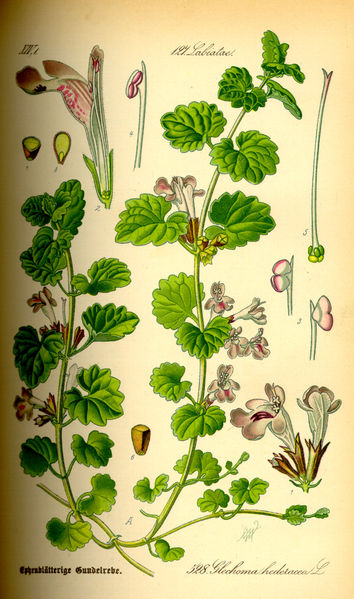
Image from Wikipedia, source: Prof. Dr. Otto Wilhelm Thomé Flora von Deutschland, Österreich und der Schweiz 1885, Gera, Germany
[This post is my contribution to the Blog Party being hosted by an amazing herbalist, Darcey Blue French, at http://desertmedicinewoman.blogspot.com/ on the theme of "Weeds of Summer that you love to love, that others love to hate...."]
Weeds are the outlaws of the plant world -- plants that escape cultivation and resist eradication, slipping in where they aren't wanted, subverting the gardener's idea of control. Medicinal allies of the common people, dismissed by the medical profession throughout history (think of the plants whose Latin binomials contain the word vulgaris.)
Neither of Ground Ivy's Latin names (Glechoma Hederacea or Nepeta Glechoma) contain the word vulgaris, but Ground Ivy otherwise fits the definition well. According to a website maintained by Purdue University's School of agriculture "Ground ivy is difficult to control and it is a problem in 31% of lawns maintained professionally in Indiana." The State of Connecticut officially made Ground Ivy an outlaw, banning its cultivation in 2004. They were, of course, a bit late -- the tiny creeping mint came over with the first colonists who used it to make medicine and ale.
(Alehoof was a common name for the plant a few hundred years ago, reflecting its use as a bitter in beermaking prior to the standardization of beer composition that began with the German Beer Purity Law of 1516, a law designed in large part to end the production and consumption of psychotropic and aphrodesiac beers. See Stephen Harrod Buhner's Sacred and Healing Herbal Beers for more on this history.)
Ground Ivy was popular in British and American folk medicine well into the nineteenth century. Maude Grieve wrote:
"From early days, Ground Ivy has been endowed with singular curative virtues, and is one of the most popular remedies for coughs and nervous headaches. It has even been extolled before all other vegetable medicines for the cure of consumption.Despite (or more likely because of) its popularity, Ground Ivy was not well regarded by physicians of the late nineteenth and early twentieth centuries. In 1869, William Cook wrote that "the marvelous repute it once enjoyed in England, has very properly faded away." The 1918 edition of the Dispensatory of the United States of America said:"An excellent cooling beverage, known in the country as Gill Tea, is made from this plant, 1 OZ. of the herb being infused with a pint of boiling water, sweetened with honey, sugar or liquorice, and drunk when cool in wineglassful doses, three or four times a day. This used to be a favourite remedy with the poor for coughs of long standing, being much used in consumption. Ground Ivy was at one time one of the cries of London for making a tea to purify the blood. It is a wholesome drink and is still considered serviceable in pectoral complaints and in cases of weakness of the digestive organs, being stimulating and tonic, though it has long been discarded from the Materia Medica as an official plant, in favour of others of greater certainty of action. As a medicine useful in pulmonary complaints, where a tonic for the kidneys is required, it would appear to possess peculiar suitability, and is well adapted to all kidney complaints"
"The herb was formerly official, and still enjoys some credit as a domestic remedy. It has a peculiar, disagreeable odor, and a bitterish, somewhat aromatic taste, and imparts its properties to boiling water. It is very prone to have galls developed on it, and to be infested with certain fungi."But in recent years, the herb has made its way back into medicine, and even into commerce.
I was introduced to Ground Ivy by Madelon Hope of the Boston School of Herbal Studies who spoke of the plant's affinity for the upper respiratory system I gathered the flowers this spring and tinctured them in 80 proof Vodka. The tincture was ready just as I had a number of clients come to me complaining of head colds marked by severe sinus congestion, slight throat irritation and inflamation, and minor swelling of the lymph nodes in the throat. I used Ground Ivy in a formula with Yarrow and Elder Flowers and Berries at a dosage of 30-60 drops every 4 hours depending on body weight, and most clients reported relief from all symptoms by the end of the first day. I have found Ground Ivy very effective in relieving my own sinus congestion and inflamation.
David Winston speaks of several uses I have not yet explored in his section on the plant in his American Extra Pharmacoepia, including:
- clearing toxic heat from the liver and gallbladder and promoting bile excretion
- getting the blood moving and reducing swelling in traumatic injuries
- increasing lead excretion in urine
This little outlaw who grows close to the ground and quickly overtakes yards and pastures is fast becoming one of my favorite medicinal plants.
Subscribe to:
Posts (Atom)